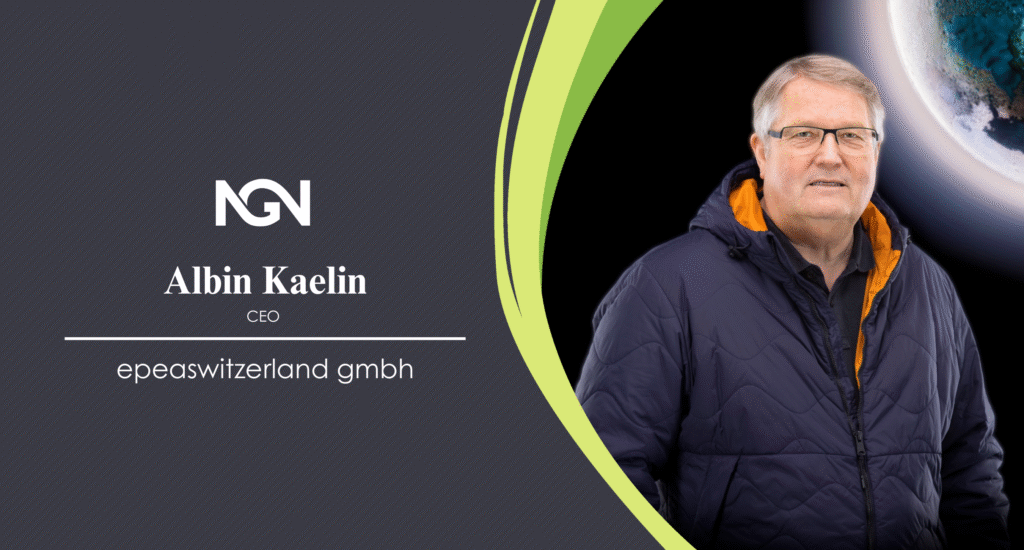
The morning begins in a quiet corner of Switzerland.
Where soft light spills over the ridges of the mountains and drifts slowly into a modest office space. Papers rest neatly where they were left the night before, a pen sits poised on the edge of a notebook, and a gentle stillness settles into the room. Standing near the window is Albin Kaelin—steady, thoughtful, almost contemplative—as he observes the landscape like someone studying a pattern they’ve spent a lifetime deciphering. To anyone passing by, he might appear to be easing into a calm workday. Yet beneath that composed stillness rests a mind that has challenged decades of industrial assumptions and reshaped how the world thinks about materials, innovation, and environmental responsibility.
His journey does not begin with a corporate boardroom or a laboratory breakthrough.
It begins with a childhood moment so quiet and ordinary that no one around him could have imagined its impact. As a young boy, Albin was naturally left-handed, but his teachers demanded he write with his right. When he asked why, no answer came. The silence that followed was his first encounter with a rule that existed without reason. Instead of accepting it, he absorbed a deeper truth: when something makes no sense, question it. When the world presents a system built on outdated assumptions, dare to challenge it. That early experience planted a seed of rebellion—not violent or dramatic, but curious, patient, precise, determined and persistent. It became the root of the mindset that would guide him for the rest of his life.
Years before sustainability became a global conversation, he was already paying attention.
Long before circularity appeared in corporate strategies or legislative frameworks, Albin saw a problem that others were too busy to acknowledge. Products were made to be used briefly and thrown away. Materials lost their value after a single cycle. Factories produced waste as though the earth could endlessly absorb it. Industries functioned as if resources were infinite and consequences irrelevant. None of it aligned with the logic he trusted. In nature, nothing is wasted. Everything becomes nourishment for something else. Circularity is not an invention—it is simply how the natural world works. The more he observed these contradictions, the more obvious it became that the industrial world was drifting far from the principles that sustain life.
Innovation doesn’t begin with answers. It begins with the courage to question what no longer makes sense
These observations shaped the direction of his career long before the world was ready for the conversation.
When he entered the textile industry, he didn’t see bolts of fabric or product lines. He saw ecosystems. He saw chemistry. He saw the invisible consequences of decisions made far from the consumer’s eye. In an era when industrial leadership measured success by speed, volume, and expansion, Albin quietly gravitated toward questions of safety, responsibility, and renewal. While most executives analyzed profit curves, he studied dye formulas. While others obsessed over market trends, he examined how materials aged, decomposed, or contaminated their surroundings. He wasn’t looking for faster results—he was looking for better ones.
His leadership at Rohner Textil marked the first major turning point.
From 1981 to 2004, he helped steer the company through an era of transformation. Under his guidance, the company earned international recognition for design innovation. But the most defining moment came in 1993, when he championed the development of what would later become the world’s first truly circular textiles. At a time when no one in the market was thinking about product life cycles or material health, he got introduced to William McDonough and Michael Braungart, the visionaries of Cradle to Cradle. They proposed a concept that seemed almost unrealistic: design materials that behave like nutrients—safe, cyclical, endlessly reusable.
The Climatex® breakthrough was not just a new product.
It was a statement. A model. A challenge to every factory, designer, and executive who believed waste was inevitable. The idea was both simple and revolutionary: create something that could return to the earth or the production system without harm. No toxic dyes. No chemical residues. No loss of material quality. Only continuous usefulness. The success of Climatex® became a catalyst, demonstrating that industries didn’t need to choose between performance and responsibility—they could have both if they were willing to rethink the system itself.
Radical innovator became the foundation of his life’s work.
After leaving Rohner Textil, he became the CEO of EPEA (Environmental Protection Encouragement Agency), the scientific institute of Michael Braungart in Hamburg, Germany and in the Netherlands. In 2009 Albin founded epeaswitzerland, a consultancy built not merely to advise companies but to guide them through genuine transformation. From the outside, it may appear like a consulting firm, but in truth, it operates more like a laboratory of ideas, creating radical innovations —a bridge between nature’s logic and industrial reality. He built a team capable of navigating chemistry, engineering, design, legislation, supply chains, and the finer points of circular attestation to a new product development of a Digital Product Passport Compass Cradle to Cradle™️ . Companies across Europe, the United States, Asia and beyond came to him not for superficial sustainability strategies but for deep structural rethinking.
When we design with responsibility, we don’t just change products — we change the future that holds them
What sets him apart is not ambition but clarity.
He does not believe sustainability is a trend or a public relations tool. He sees it as a responsibility—a practical, scientifically grounded responsibility to align human systems with the laws of nature. His approach is not emotional or ideological; it is rational. When he speaks about material safety or circular design, he does so with the same calm precision he brings to observing the morning mountains. He is not trying to impress. He is trying to reveal a pattern that has always been there, waiting to be recognized.
Over the years, he has become a trusted guide to industries navigating the complexities of transformation. From building & construction industry, furniture brands, cleaning product companies, packaging leaders, textile suppliers, wood, metal and plastic industry—all turned to him when they realized their old systems could no longer carry them into the future. In boardrooms around the world, he has helped leaders understand that circularity is a strategic management approach requiring much creativity. Circularity tools and circular accounting methodologies were developed for managers to enable the change of mindset. It reduces risk, ensures material availability, and aligns with evolving regulations. It safeguards companies from the vulnerabilities of linear supply chains. It builds resilience—economic, environmental, and operational success.
Leadership, for Albin, has never been about volume or visibility.
It has always been about steadiness—the kind of steadiness that gives others room to think, to question, to discover their own clarity. In a business world often dominated by noise, urgency, and inflated promises, his calm approach feels almost radical. He does not attempt to dazzle audiences with futuristic predictions. Instead, he walks them through timeless patterns, showing how aligning with natural cycles is not just sustainable—it is unmistakably logical.
Circularity is not a destination. It’s a mindset, a discipline, and a promise to do better with every cycle
Colleagues often describe him as a “grounding presence.”
Someone who brings meetings back to what truly matters. Someone who listens deeply and speaks only when there is something worth saying. Someone who sees beyond the noise of short-term pressures and connects decisions to long-term consequences. In an age of constant acceleration, he brings people down to earth—not to delay progress, but to anchor it.
In many ways, his leadership is a form of quiet activism.
Not the kind that shouts or demands, but the kind that shifts perspectives through calm conviction. He has influenced countless leaders and peers on the shopfloor simply by showing them what they could not see on their own. In a world that often confuses speed with intelligence, he reminds people that clarity is what truly drives innovation.
What’s remarkable is how naturally mentorship flows from him.
Whether speaking with young innovators or seasoned executives, he offers his knowledge freely, without ego or agenda. He knows that the future will require more than regulations or certifications—it will require people who think differently, who design differently, who lead differently. And he believes deeply in supporting them.
For someone who has influenced global industries, he carries no sense of superiority.
Instead, he carries purpose—steady, grounded purpose. He travels frequently, advises constantly, supports companies tirelessly, yet maintains the same calm presence wherever he goes. When asked about his demanding schedule, he smiles and says, “Tomorrow I will be on the road again,” as if the road is not a burden but a continuation of a story
Today, the world is finally catching up to the ideas he championed decades ago.
Circularity is now a strategic priority. Governments are embedding regeneration into policy frameworks. Businesses are rethinking product design, material choices, and supply chain models. And as industries navigate this new era, Albin’s work stands as an anchor that others can build upon.
Yet even as global recognition grows, he remains anchored to the simplicity of his original insight.
When something makes no sense, question it. When a system causes harm, redesign it. When the world offers a rule without reason, create a better one. His rebellion was never about defiance for its own sake—it was about responsibility.
The world doesn’t transform through force. It transforms when enough people choose logic, clarity, and purpose over habit
His legacy is not measured in awards, though he has received dozens.
It is measured in the products that no longer become waste. The packaging that re-enters the cycle. The textiles that nourish rather than pollute. The factories redesigned for closed-loop production. The leaders who now think differently. The young innovators he continues to inspire. The companies whose systems, products, and philosophies have been transformed.
His groun-breaking book “From Rebel to Radical Innovator; Leading the Transformation through Circularity” is acknowledged with excellent reviews.
The transformation from a linear to a circular mindset is a challenge for everyone. With his book, he wanted to give something back to managers, students, and society. The know-how, approach, results, and tools gained from decades of work in development and innovation provide guidance and clarity. It combines scientific insights with leadership philosophy, offering a rare blend of practicality and wisdom. Readers often describe it as a conversation with someone who understands both the urgency of global challenges and the patience required to overcome them and translate them into successful businesses.
Albin Kaelin’s story is not loud, dramatic, or rushed.
It unfolds like the morning in Switzerland—quietly, steadily, with purpose and clarity. It reminds us that real innovation does not always begin with disruption; sometimes it begins with a simple question asked by a curious child. Sometimes it begins with noticing what others overlook. Sometimes it begins with the courage to see the world not as it is, but as it could or should be.
In every way that matters, his journey is a testament to the power of thoughtful rebellion.
A rebellion that questioned the unnecessary, challenged the illogical, and ultimately helped reshape industries across the globe. And as the world continues to transform, his influence will remain woven into the systems, philosophies, and materials that carry us into the future.