
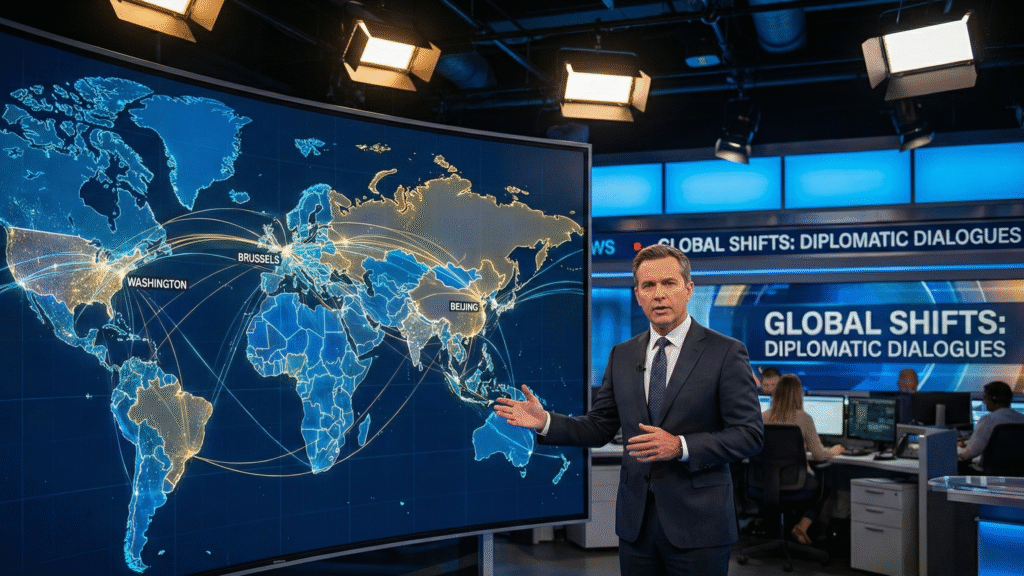
The global political order is undergoing a rapid shift as countries reassess their alliances and security priorities. From Europe to Asia and the Middle East, governments are adjusting their foreign policies to adapt to a world defined by new economic pressures, technological competition, and rising regional conflicts.
In Europe, NATO remains central to the continent’s security posture, but internal debates continue. France and Germany are pushing for a stronger, more independent European defense structure. Their argument is simple: Europe must be prepared to handle regional threats without depending entirely on the United States. Several EU members support the idea, citing growing uncertainty in U.S. foreign policy.
Asia is also experiencing accelerated geopolitical movement. Japan and South Korea—two countries with a long history of political tension—are strengthening cooperation in intelligence sharing and defense technology. Their renewed alignment is seen as a response to China’s expanding military presence in the region, especially in the South China Sea.
China, meanwhile, is doubling down on its global influence strategy. While the Belt and Road Initiative has faced criticism over debt burdens, Beijing is shifting toward digital influence by investing in AI infrastructure, 5G networks, and green-energy corridors across Africa and Southeast Asia. Analysts say these areas will become the new battlegrounds for global economic dominance.
The Middle East is entering a period of cautious recalibration. Gulf countries, including the UAE and Saudi Arabia, are pivoting toward economic diversification. Their foreign policies are now more aligned with technology partnerships, green energy investments, and logistics expansion. Traditional oil-based alliances are giving way to multi-sector collaborations.
In Africa, regional unity is gaining momentum. The African Continental Free Trade Area is slowly reshaping the continent’s economic landscape, giving African governments more bargaining power in global negotiations. Countries like Kenya, Nigeria, and Rwanda are positioning themselves as digital-economy leaders, attracting new partnerships from Europe and Asia.
In the Americas, the United States is working to rebuild multilateral ties while facing deep internal political divisions. Latin American nations are navigating their own political cycles, with several governments shifting their foreign policy positions to attract investment and reduce reliance on traditional partners.
Across the world, one pattern is clear: nations want flexibility, autonomy, and diversified alliances. The era of exclusive geopolitical blocs is fading. Instead, countries are forming issue-based partnerships—on technology, energy, climate, or defense—depending on what serves them best.
The next 12 months could redefine global power structures. Whether cooperation strengthens or fractures will depend on how major nations manage competition in a rapidly changing world.