
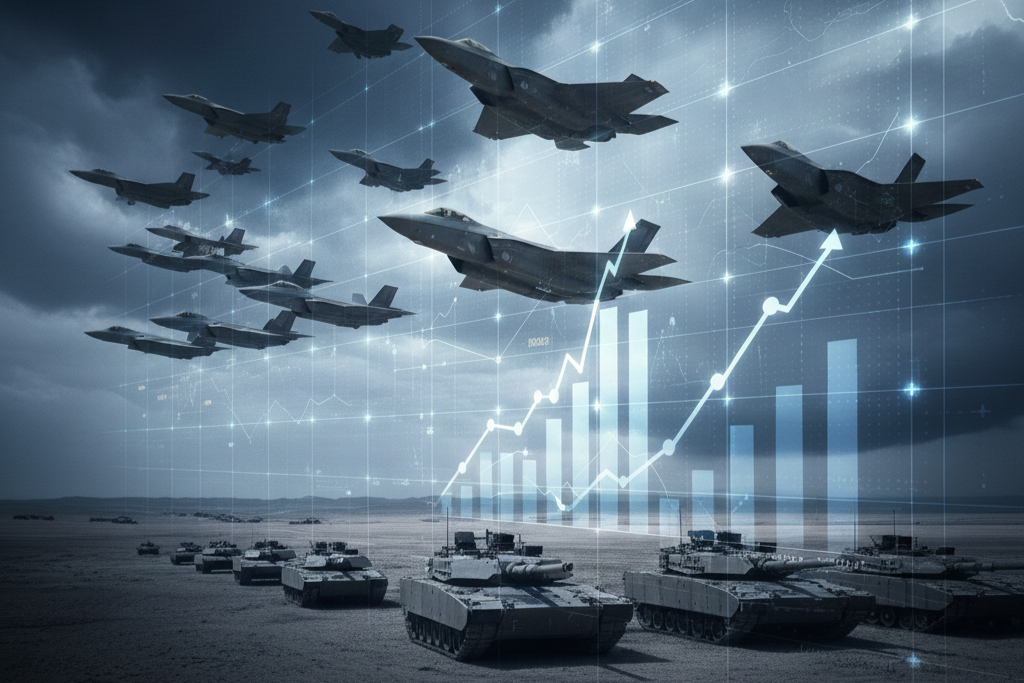
Global defense spending has reached its highest level in modern history as countries respond to rising geopolitical tensions, cyber threats, and emerging military technologies. According to several international reports, worldwide defense expenditure grew significantly in the last 12 months, reflecting a shift in national priorities as governments brace for unpredictable global security challenges.
The United States continues to lead global spending, driven by investments in AI-enabled warfare systems, missile defense improvements, and naval expansion. Officials say the rise is largely due to heightened competition with China and the need to modernize aging military infrastructure.
China ranks second, with rapid advances in drone warfare, space-based surveillance, and naval capabilities. Beijing’s continued focus on the South China Sea and its increasing assertiveness in regional waters have prompted neighboring countries to rethink their security strategies.
Europe has also accelerated defense budgets. Russia’s ongoing military assertiveness has pushed NATO members to meet or exceed the 2% target for defense spending. Poland, Finland, and the Baltic states have seen some of the region’s fastest increases, prioritizing air defense systems, cross-border surveillance, and long-range strike capabilities.
Asia is undergoing a similar shift. Japan has approved one of its largest defense budgets in decades, emphasizing missile defense, cybersecurity, and space monitoring. South Korea is strengthening its technology-based defense systems amid concerns over missile activity in the region.
In the Middle East, defense priorities are evolving. While traditional military strength remains central, governments are investing heavily in digital security, surveillance technology, and unmanned systems. The focus is shifting from manpower to strategic tech-driven protection.
Africa’s defense landscape is changing as well. Many nations are using limited budgets to counter terrorism, piracy, and regional instability. Partnerships with Europe, the U.S., Turkey, and China continue to expand, especially in areas of training and technology transfer.
Beyond traditional military spending, cyber defense has emerged as one of the fastest-growing budget categories. Countries are establishing specialized cyber commands to counter ransomware, political hacking, and digital espionage. Analysts warn that cyber conflicts between major powers could escalate quickly if safeguards are not strengthened.
As nations invest more in defense, concerns are rising about the long-term impact on economic stability. However, governments argue that higher spending is necessary to secure national borders in an increasingly volatile world.
With global tensions still high, defense budgets are expected to grow further in the coming year, marking a new phase of technology-driven geopolitical competition.