
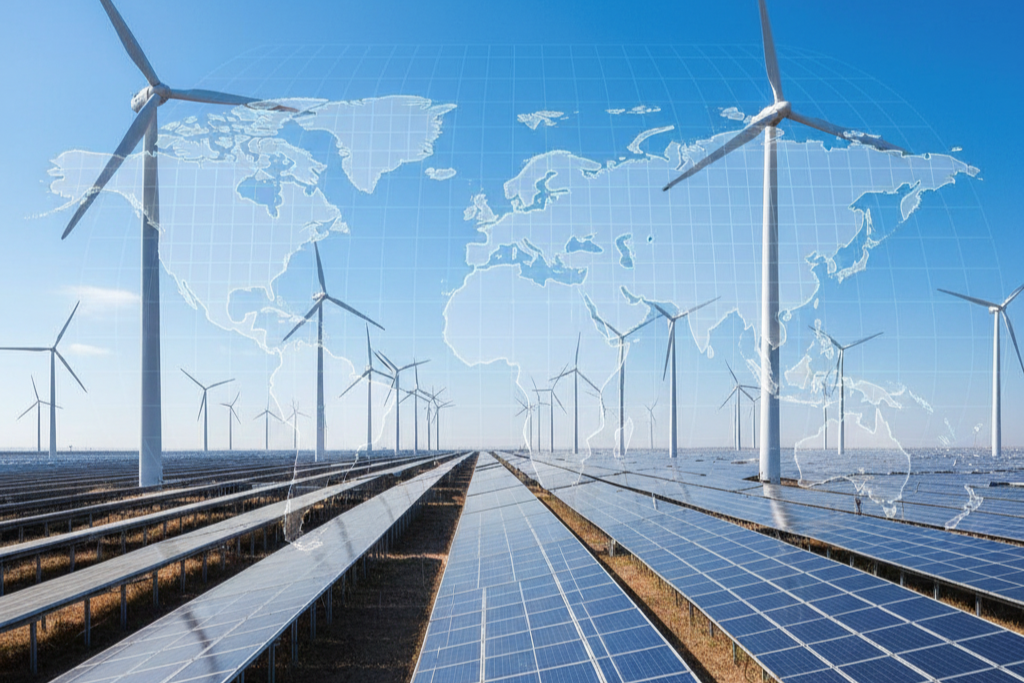
The global race toward renewable energy is transforming international politics. Countries are restructuring alliances, competing for green technology leadership, and adjusting trade partnerships to secure long-term access to clean energy resources.
China remains the world’s largest producer of solar panels, batteries, and renewable components. Its dominance in the supply chain has prompted other nations to diversify production through new manufacturing hubs in India, Southeast Asia, and Europe.
The United States is accelerating clean-energy investments, focusing on advanced battery manufacturing, wind farms, and electric vehicle infrastructure. Washington is forming new energy alliances in the Indo-Pacific and Latin America to secure rare-earth minerals essential for renewable technologies.
Europe is pushing hard toward energy independence. Massive offshore wind projects, hydrogen corridors, and solar-farm expansions are reshaping the region’s energy map. The EU is also introducing stricter carbon policies that could influence global trade.
In the Middle East, oil-rich nations are accelerating their transition strategies. Saudi Arabia and the UAE are investing heavily in green hydrogen, solar megaprojects, and carbon-neutral city planning. Their goal is to become global energy players even in a post-oil world.
Africa holds enormous renewable potential. Countries like Morocco, Kenya, and South Africa are emerging as leaders in solar and wind production. However, many African nations still need greater investment in grid modernization and energy storage.
As nations compete for leadership, renewable energy is becoming a central factor in foreign policy decisions. The countries that secure long-term dominance in clean energy may define the next era of global economic power.