
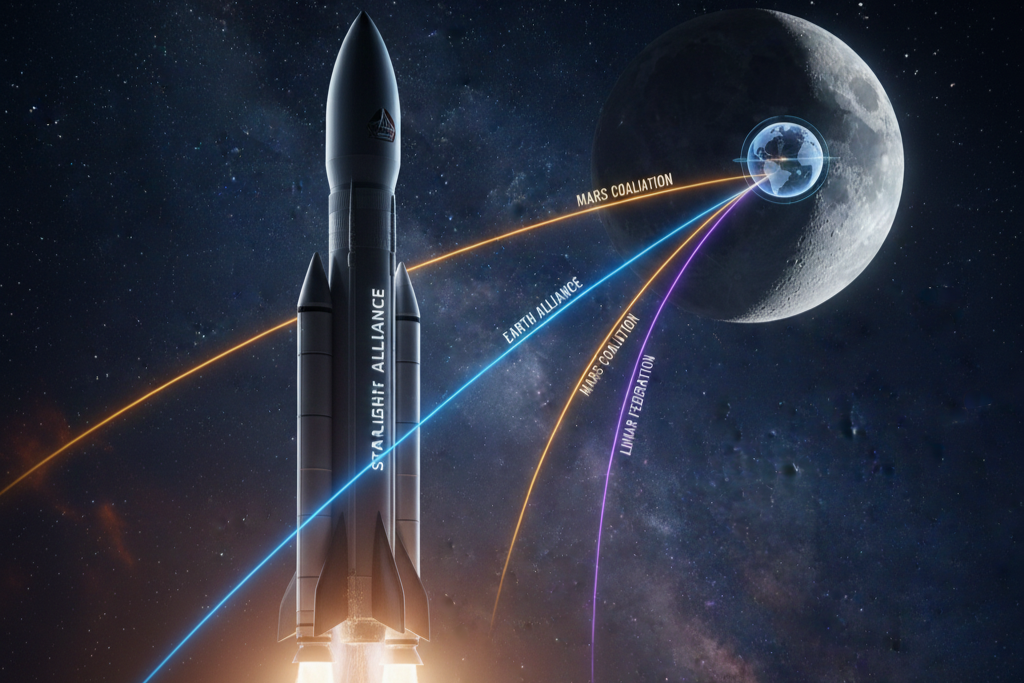
A renewed global race toward lunar exploration is unfolding as world governments and private companies prepare for the eventual retirement of the International Space Station (ISS) by the end of the decade. The shift marks a major turning point in space strategy — moving from low-Earth orbit operations to ambitious multi-nation lunar programs and permanent Moon-based infrastructure.
During a recent high-level space summit in Glasgow, more than 2,000 space agency officials, aerospace companies, and government representatives gathered to discuss post-ISS cooperation models. The conversations made one thing clear: the Moon is becoming the next major geopolitical and commercial arena.
Two Major Global Blocs Are Emerging
The space summit highlighted the formation of two dominant space alliances.
The first is led by the United States, Japan, Canada, and the European Union under NASA’s Artemis Program. The coalition aims to return humans to the lunar surface, build a permanent lunar base, and establish a logistical gateway station orbiting the Moon.
The second bloc is driven by China and Russia, who have announced their own joint lunar research station scheduled for the early 2030s. Several developing nations — including Pakistan, Iran, Venezuela and parts of Africa — are exploring partnerships with this alliance.
Experts say this alignment resembles early Cold War space rivalry, but with a modern twist: today the competition includes commercial incentives, lunar mining potential, and orbital infrastructure — not just national pride.
Private Space Companies Are Now Key Players
Unlike the 1960s race to the Moon, private companies now sit at the center of development. Firms such as SpaceX, Blue Origin, ISRO-backed startups, ESA-supported aerospace groups, and multiple European and Japanese space-tech companies are securing contracts worth billions.
Reusable rockets, autonomous landing modules, and advanced propulsion technology are accelerating timelines and cutting launch expenses — making lunar initiatives more realistic and financially sustainable than ever before.
Why the Moon? The Strategic Value Is Growing
The Moon’s significance is not symbolic — it is strategic.
Scientists say the lunar south pole contains water ice deposits that could be converted into hydrogen and oxygen — crucial elements for future deep-space fuel production.
If developed successfully, the Moon could become a refuelling checkpoint for missions travelling deeper into the solar system, including Mars — or even a logistics hub for commercial satellites and solar energy harvesting.
There is also growing interest in rare minerals and helium-3 — a potential clean nuclear-fusion fuel.
International Governance Questions Are Growing
Despite enthusiasm, the rapid acceleration has raised important questions:
- Who owns lunar resources?
- How will mining rights be defined?
- Can military technology be deployed near the Moon?
- Will space debris become the next geopolitical dispute?
The 1967 Outer Space Treaty bans national ownership of celestial bodies, but it never anticipated commercial mining or artificial habitats. More than 25 countries have signed the U.S.-backed Artemis Accords, which attempt to define responsible exploration standards — but Russia, China, and several emerging space nations have rejected them.
Without updated global agreements, analysts warn that the Moon could become a new frontier for geopolitical tension.
Public Interest and Pop Culture Are Fueling Momentum
Search trends and social media analytics reveal that global interest in space has surged in 2025. Streaming documentaries, games featuring space exploration, and high-profile live rocket broadcasts have helped bring space science back into mainstream culture.
Younger audiences in particular see the Moon not as a distant milestone of the past — but as the next live event they may witness in real time.
A New Chapter Begins
The transition from the ISS era to a lunar-driven future signals a new chapter in humanity’s relationship with space. Whether this next phase becomes a platform for cooperation, conflict, or commercial innovation will depend on the negotiations and decisions taking place right now.
One thing is clear: the world isn’t just going back to the Moon — it’s preparing to stay.