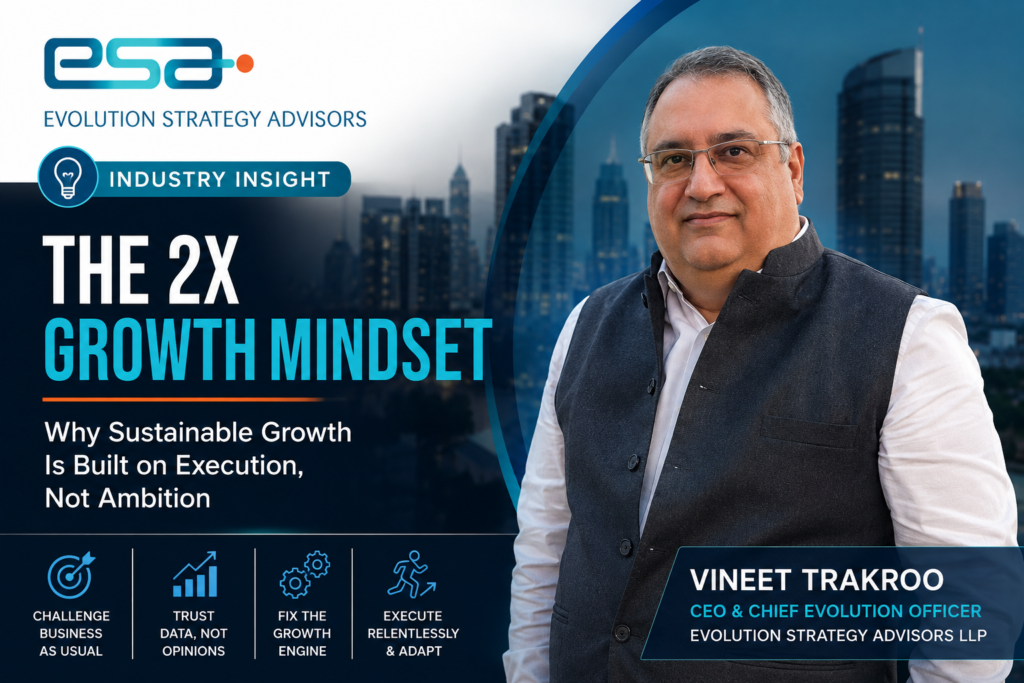
An Industry Insights Conversation with Vineet Trakroo
CEO & Chief Evolution Officer, Evolution Strategy Advisors LLP
The Hidden Barriers to Growth
Ask ten CEOs why businesses struggle to grow, and you’ll probably hear ten different answers. Some blame market conditions, others point to competition, changing consumer behaviour, or economic uncertainty. Vineet Trakroo sees it differently.
Early in our conversation, he introduces a phrase that quietly becomes the thread connecting every topic we discuss Business As Usual (BAU).
It’s not a management buzzword, nor is it a criticism of successful organisations. In Vineet’s view, it’s one of the biggest reasons businesses stop growing.
“Most organisations don’t fail because they lack ambition,” he says. “They stop growing because they become comfortable doing what worked yesterday.”
It’s a surprisingly simple observation, yet one that resonates across industries. As businesses expand, leaders naturally become consumed by operational priorities. Quarterly targets, customer demands, internal reviews, hiring decisions, and daily problem solving leave little room to step back and ask a far more important question:
Are we still doing things the best way possible?
According to Vineet, that’s where the first signs of stagnation begin to appear. Organisations become efficient at repeating established processes but gradually lose the curiosity that created their success in the first place.
Growth, he believes, doesn’t disappear overnight. It slows quietly, hidden beneath familiar routines that nobody thinks to question.
Seeing What Others No Longer Notice
One of the more interesting observations Vineet makes is that experience can sometimes become a limitation.
The longer leaders work within the same organisation, the more familiar they become with its people, processes, and culture. While that knowledge is invaluable, it can also make inefficiencies surprisingly difficult to recognise.
“Being too close to the business often prevents leaders from seeing what’s obvious,” he explains.
That’s one of the reasons organisations often benefit from an external perspective. Someone looking at the business without years of internal assumptions can identify opportunities, bottlenecks, or outdated practices that have gradually become accepted as normal.
For Vineet, transformation rarely begins with a dramatic change. More often, it starts by questioning assumptions that nobody has challenged for years.
Why Opinions Rarely Solve Business Problems
As our discussion moves towards business diagnostics, Vineet becomes noticeably more direct.
Every organisation, he says, has opinions.
Marketing believes the challenge lies with sales.
Sales points towards product.
Operations identify execution gaps.
Leadership hears multiple explanations, each influenced by individual experience.
Rather than beginning with opinions, Vineet begins somewhere much simpler.
“Data doesn’t lie.”
It’s a statement he returns to several times throughout our conversation.
Whether analysing customer acquisition, operational efficiency, pricing performance, or supply chain effectiveness, he believes every business leaves measurable evidence about what’s working—and what’s not.
The role of leadership isn’t to collect more opinions.
It’s to ask better questions of the data already available.
Patterns often emerge long before problems become visible in financial results. Businesses that recognise those signals early gain time to respond, adapt, and improve before performance begins to decline.
Looking Beyond the Sales Team
One misconception Vineet encounters frequently is the tendency to blame slowing sales on the sales function itself.
He disagrees.
“In many organisations, sales isn’t actually the problem,” he says. “It’s simply reflecting issues that already exist elsewhere.”
Weak product positioning, inconsistent customer experience, operational bottlenecks, pricing decisions, delayed fulfilment, or inefficient internal processes often affect commercial performance long before a salesperson meets the customer.
Focusing only on sales, therefore, risks treating the symptom rather than the underlying cause.
His approach is to understand how every stage of the customer journey connects to the next. Once organisations begin fixing those underlying processes, commercial performance often improves naturally.
It’s a reminder that sustainable growth is rarely created by one department alone. It is the outcome of an organisation working together with clarity, accountability, and consistent execution.
As our conversation progresses, one thing becomes increasingly clear.
For Vineet Trakroo, growth has very little to do with chasing bigger numbers.
It begins with challenging assumptions, trusting evidence over instinct, and having the discipline to improve the systems that drive business performance every day.
And that’s only the beginning of the conversation.
Why Strategy Alone Never Creates Growth
By the time our conversation shifts from diagnosing business problems to discussing strategy, Vineet Trakroo challenges another widely accepted belief.
Many executives associate strategy with boardroom discussions, ambitious presentations, and long term planning documents. While those have their place, he believes they often receive far more attention than they deserve.
“People sometimes think strategy is the hardest part,” he says with a smile. “I don’t.”
Instead, he offers a definition that is both simple and refreshingly practical.
“Strategy is simply a choice.”
Markets evolve. Consumer behaviour changes. Technology reshapes industries. Government policies influence business environments. Every organisation eventually reaches moments where leadership must decide whether to stay the course or adapt.
Making that choice is important.
But, according to Vineet, it’s only the beginning.
Without hesitation, he follows with a statement that has become central to his consulting philosophy.
“Growth is 10% strategy and 90% execution.”
It’s a perspective shaped by years of working with promoter led businesses, professionally managed Indian companies, and multinational organisations pursuing ambitious growth targets.
“The best strategies don’t create results,” he explains. “People do.”
Execution means far more than completing projects or meeting deadlines. It requires aligning people, processes, systems, and leadership around a common objective. When those elements work together, organisations move with purpose. When they don’t, even the strongest strategy remains little more than an impressive presentation.
Leadership Creates Direction. Culture Sustains It
Throughout our discussion, Vineet returns repeatedly to one theme—leadership.
Not leadership as authority or hierarchy, but leadership as the ability to shape how an organisation thinks and behaves.
He believes every successful organisation reflects the mindset of its leadership team.
“Leadership decides the pace of growth. Culture delivers it.”
It’s a statement that captures the relationship between vision and execution.
Leaders define priorities, set expectations, and make strategic choices. Culture determines whether those choices become everyday behaviour across the organisation.
Companies that consistently outperform competitors rarely do so because they employ extraordinary people alone. They succeed because accountability, ownership, and continuous improvement become embedded in the way the business operates.
Those qualities cannot be introduced during annual reviews or strategy workshops.
They must be lived every day.
The Balancing Act Facing Today’s CEOs
No discussion about business growth would be complete without acknowledging the environment in which today’s leaders operate.
Economic uncertainty continues to influence investment decisions. Consumer expectations evolve rapidly. Digital transformation is reshaping industries. Shareholders expect stronger financial performance while employees expect greater flexibility and purpose.
Many executives view these challenges independently.
Vineet doesn’t.
“They’re all connected,” he says. “A CEO isn’t managing one challenge at a time. They’re balancing all of them simultaneously.”
He compares leadership to keeping multiple moving pieces in equilibrium. Focusing too heavily on one area while neglecting another often creates unintended consequences elsewhere in the business.
The role of leadership, therefore, isn’t simply making decisions.
It’s making balanced decisions.
Why AI Will Reward Businesses That Already Execute Well
Artificial Intelligence has become impossible to ignore, and like many business leaders, Vineet sees enormous opportunity in its evolution.
Yet he believes the conversation often becomes too focused on technology itself.
“AI dramatically improves our ability to analyse information,” he explains. “It helps us identify patterns, evaluate possibilities, and make faster decisions.”
That’s a significant advantage.
But AI doesn’t eliminate the need for leadership.
Recommendations still require judgement.
Insights still need action.
Strategies still demand disciplined execution.
Technology may accelerate decision making, but it cannot replace accountability or organisational capability.
Businesses that already execute well will become even stronger by using AI effectively.
Those with weak execution, however, are unlikely to solve their problems simply by adopting new technology.
As our conversation reaches this point, Vineet’s philosophy becomes increasingly consistent.
Whether discussing strategy, leadership, culture, or Artificial Intelligence, every idea leads back to the same principle.
Growth isn’t driven by isolated initiatives or short term wins.
It is created by organisations that make better decisions, execute consistently, and remain willing to adapt before circumstances force them to change.
That foundation, he believes, is what separates businesses that experience temporary success from those that build lasting competitive advantage.
Building Businesses That Are Ready for Tomorrow
As our conversation entered its final phase, the discussion shifted from leadership philosophy to something far more practical—how organisations should measure success and prepare for the future.
For decades, businesses have relied on familiar indicators such as revenue, market share, and profitability to judge performance. Vineet agrees these numbers matter, but he believes they tell only part of the story.
“Revenue tells you what has happened,” he says. “It doesn’t always explain why it happened.”
Instead, he encourages business leaders to look deeper into the operational health of their organisations.
Every stage of the customer journey leaves measurable signals—from lead generation and customer acquisition to order fulfilment, collections, customer retention, and repeat business. Each stage has its own conversion rate, and every drop in that conversion points to an opportunity for improvement.
“The strongest businesses don’t just measure outcomes,” Vineet explains. “They measure the efficiency that creates those outcomes.”
Cash flow, inventory movement, customer retention, sales productivity, and process efficiency often reveal far more about a company’s future than revenue figures alone. Leaders who understand these indicators are better equipped to identify problems early and make informed decisions before performance begins to decline.
Every Business Has a Different Growth Story
Given Evolution Strategy Advisors’ reputation for helping organisations accelerate growth, I asked Vineet whether there is a common formula for building a business that can double its size.
His answer was immediate.
“There isn’t one.”
Every organisation, he explains, operates under different circumstances. Industries behave differently. Markets evolve at different speeds. Leadership teams have different strengths, cultures, and ambitions. Applying the same solution to every company rarely produces meaningful results.
That’s why his team begins every engagement by understanding the business before recommending change.
“We don’t walk in with readymade answers,” he says. “We begin by understanding where the business is today and where it wants to go.”
Only then does Evolution Strategy Advisors develop a structured roadmap covering business diagnostics, growth opportunities, execution priorities, governance, and performance monitoring.
For Vineet, the objective is never to deliver another strategy document.
The objective is to create an organisation capable of executing consistently long after the consultants have left.
Looking Towards 2030
No conversation about growth would be complete without discussing the future.
India’s B2C landscape is changing rapidly, and Vineet believes the pace of transformation will only accelerate over the coming years.
Consumers are becoming more informed, digital adoption continues to increase, and expectations around convenience, speed, and customer experience are higher than ever before.
He points to the rapid rise of quick commerce as an example of how quickly customer behaviour can reshape entire industries.
“Whether every business model survives isn’t the real question,” he says. “The important point is that customer expectations have changed.”
Businesses that fail to recognise those shifts risk becoming irrelevant regardless of how successful they have been in the past.
Future leaders, he believes, will need a broader skill set than previous generations.
Understanding finance or marketing alone will no longer be enough.
Tomorrow’s CEOs must be equally comfortable with technology, analytics, operations, and organisational transformation.
“The future belongs to leaders who are willing to keep learning.”
The Legacy of Leadership
As our conversation drew to a close, I asked Vineet what single piece of advice he would leave with business leaders striving to build organisations that remain successful for decades rather than years.
He paused for a moment before answering.
“Change is the only constant.”
It’s a phrase most business leaders have heard before, but Vineet gives it a deeper meaning.
Markets will evolve.
Technology will continue advancing.
Consumer behaviour will keep changing.
The organisations that thrive won’t necessarily be the biggest or the oldest. They’ll be the ones that remain curious, challenge their own assumptions, and continue adapting before circumstances force them to.
He also believes growth carries responsibility.
Businesses should create value not only for shareholders but also for employees, customers, partners, and society. Sustainable success isn’t measured solely by financial performance; it’s measured by the positive impact an organisation leaves behind.
As we concluded our discussion, one thing stood out above everything else.
Vineet Trakroo doesn’t see growth as a destination or a quarterly milestone. He sees it as a discipline—one built on better questions, sharper decisions, consistent execution, and the humility to keep learning.
Perhaps that’s why his ideas feel less like management theory and more like practical advice for leaders navigating an increasingly complex business landscape.
In the end, businesses don’t grow because they have the best presentations or the biggest ambitions.
They grow because they never stop improving.
About the Contributor
Vineet Trakroo is the CEO & Chief Evolution Officer of Evolution Strategy Advisors LLP, a strategic consulting firm that partners with promoter led businesses, professionally managed Indian companies, and multinational organisations to accelerate sustainable growth. With deep expertise in business strategy, sales and marketing transformation, organisational effectiveness, and execution excellence, he works closely with leadership teams to help businesses unlock scalable growth, strengthen operational performance, and build organisations that are prepared for the future.
Through a practical, data driven approach, Vineet continues to champion a simple but powerful belief: lasting business success isn’t defined by strategy alone—it’s achieved through disciplined execution, continuous learning, and the courage to challenge Business As Usual.