ARTIFICIAL INTELLIGENCE · BUSINESS TRANSFORMATION
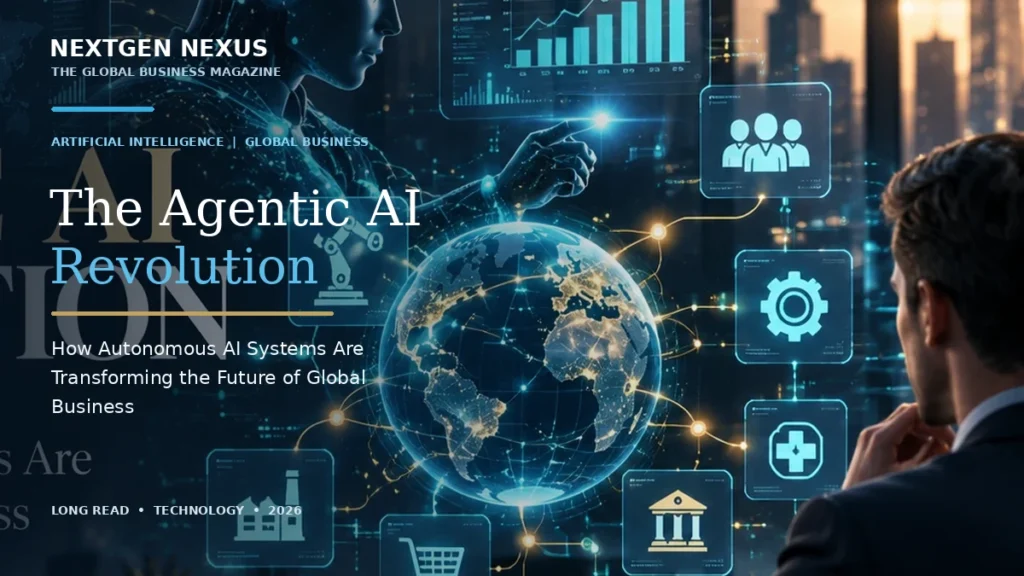
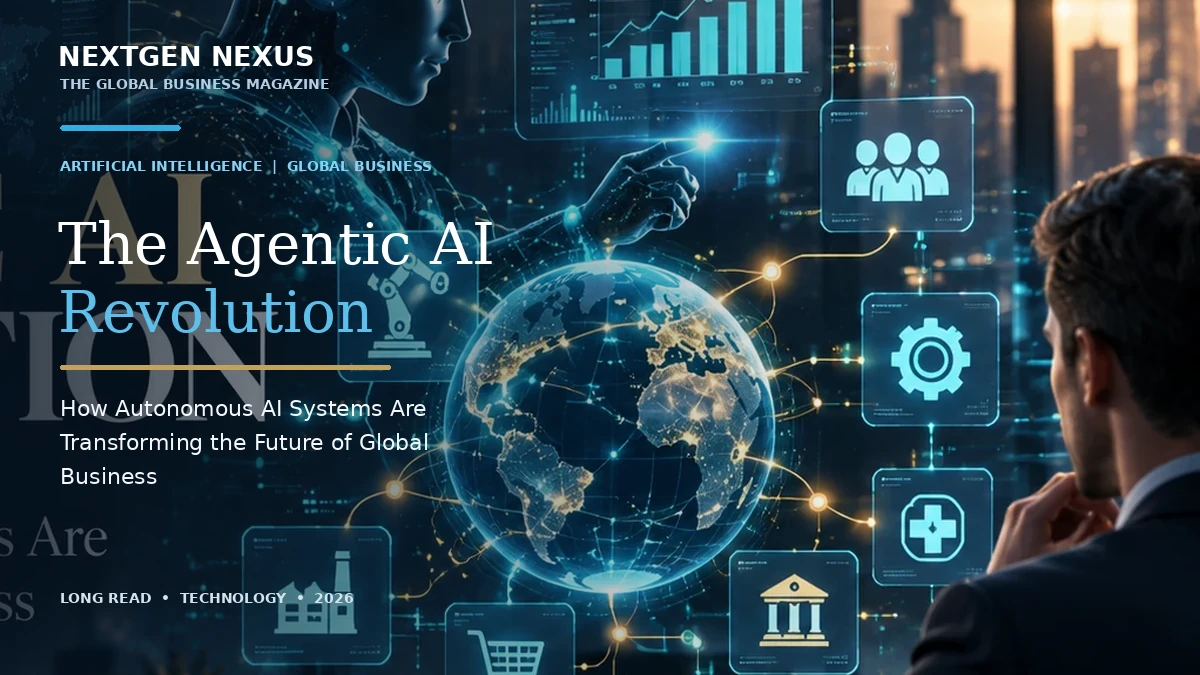
The Agentic AI Revolution
How Autonomous AI Systems Are Transforming the Future of Global Business
From intelligent assistance to autonomous execution, AI is changing how businesses plan, decide and deliver.
As organizations move from experimentation to real-world adoption, agentic systems are becoming part of the enterprise technology conversation.
Artificial intelligence is entering a new phase of development. What began with tools capable of answering questions, generating content and analyzing information is evolving into intelligent systems that can plan tasks, make decisions, interact with software and execute complex workflows with limited human intervention.
Artificial intelligence is entering a new phase of development. What began with tools capable of answering questions, generating content and analyzing information is evolving into intelligent systems that can plan tasks, make decisions, interact with software and execute complex workflows with limited human intervention.
This emerging technology, known as Agentic AI, is changing how businesses approach automation, productivity and operational efficiency. Unlike traditional AI assistants that primarily respond to instructions, AI agents can work toward defined objectives, determine the steps required and take actions across connected systems.
As organizations explore this transition, the central question is no longer simply how AI can assist employees. It is how autonomous AI systems can become an integrated part of business operations.
Understanding Agentic AI: Beyond Traditional Artificial Intelligence
Agentic AI refers to artificial intelligence systems designed to pursue specific objectives through a combination of reasoning, planning, tool usage and execution.
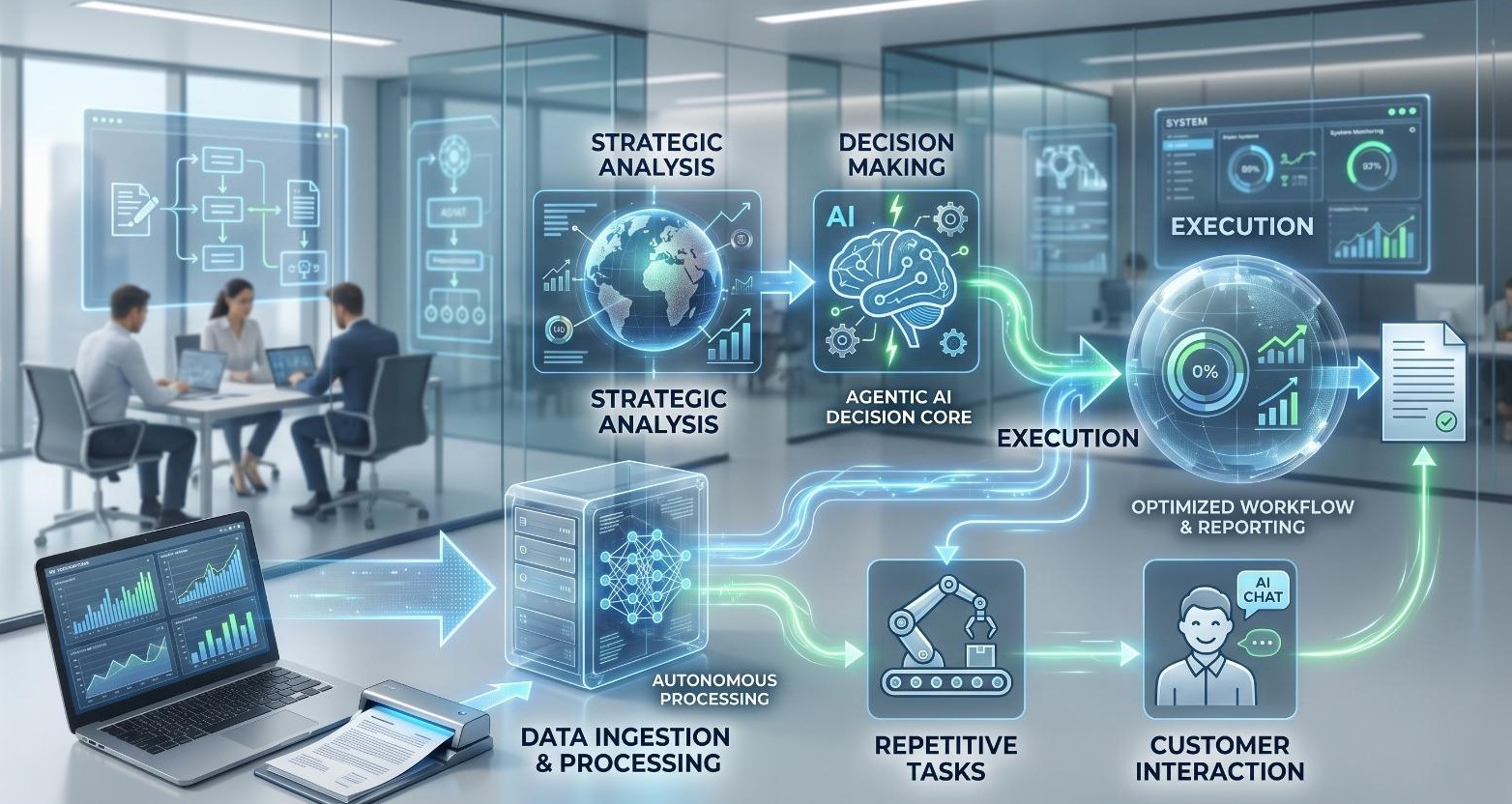
Traditional automation generally follows predefined instructions. A conventional chatbot responds to questions or generates information based on user prompts. An AI agent, however, can interpret an objective, break it into smaller tasks, interact with external tools and evaluate the results before determining its next action.
For example, a traditional customer service chatbot might answer a question about an order. An AI-powered agent could potentially identify the order, check delivery information, evaluate the customer’s request, initiate an approved replacement process and update the relevant records.
This ability to coordinate multiple activities makes agentic systems particularly interesting for organizations managing complex operations.
However, the level of autonomy varies considerably. Some agents require human approval at every important stage, while others can execute predefined actions independently within carefully established permissions.
Why Businesses Are Increasingly Investing in AI Agents
The growing interest in agentic AI reflects a broader shift in enterprise technology adoption.
According to McKinsey’s 2026 State of AI research, 44% of surveyed organizations report scaling AI across their enterprises, compared with 38% a year earlier. Among organizations with annual revenues exceeding $1 billion, 40% report scaling AI agents in at least one business function.
Figures reproduced as stated in the supplied draft and attributed there to McKinsey’s 2026 State of AI research.
These findings indicate that businesses are beginning to move beyond isolated AI experiments toward more integrated applications.
Several factors are contributing to this transition.
Operational efficiency
Businesses frequently spend considerable time managing repetitive administrative processes, processing information and coordinating activities across departments. AI agents can help automate parts of these workflows, allowing employees to concentrate on activities requiring judgment, creativity and human interaction.
Faster decision-making
Organizations generate enormous quantities of information through sales platforms, financial systems, customer databases and operational software. AI agents can help collect, interpret and organize this information to support faster decisions.
Continuous workflow management
Unlike conventional automation that may depend on fixed schedules or predefined triggers, some agentic systems can monitor changing conditions and initiate approved actions when specific requirements are met.
Greater software flexibility
AI coding agents are also changing how companies develop internal software. Businesses can increasingly explore building specialized applications and automations rather than relying exclusively on commercially available software.
Industries Being Transformed by Agentic AI
Agentic AI is being explored across sectors where complex information, repeatable processes and consequential decisions intersect.
Although agentic AI is attracting attention across the technology sector, its potential applications extend into almost every major industry.
Banking and Financial Services
Financial institutions are exploring AI agents for transaction monitoring, customer support, document processing, compliance workflows and fraud detection.
For example, an AI agent could help review transaction patterns, identify unusual activity and prepare information for a human compliance specialist.
Financial decisions involving credit approvals, investment suitability and regulatory obligations still require appropriate controls and accountability.
Healthcare and Medical Technology
Healthcare organizations face significant administrative workloads involving patient scheduling, medical documentation, insurance processing and information management.
AI agents could help coordinate these processes, organize records and support clinical administration.
However, medical diagnosis and treatment decisions require appropriate professional oversight. Patient privacy, accuracy and regulatory compliance remain essential.
Retail and E-commerce
Retail businesses can use intelligent agents to coordinate inventory monitoring, product recommendations, customer inquiries and order management.
An integrated system could identify declining inventory, prepare a replenishment recommendation and request authorization before placing a purchase order.
Such applications may improve responsiveness while reducing manual coordination.
Manufacturing and Supply Chain
Manufacturing companies operate interconnected systems involving procurement, production planning, equipment maintenance and logistics.
AI agents can potentially monitor production information, identify operational disruptions and recommend adjustments.
When integrated with industrial sensors and enterprise software, these systems could support more responsive manufacturing operations.
Marketing and Business Development
Marketing departments are also exploring agentic workflows for campaign research, audience segmentation, content planning, lead qualification and reporting.
An AI agent could gather campaign performance data, identify underperforming channels and prepare recommendations for marketing teams.
Human review remains important for brand positioning, customer communication and strategic decisions.
The Business Case: Productivity Versus Measurable Financial Value
One of the biggest challenges facing enterprise AI adoption is demonstrating that improved productivity translates into measurable financial results.
McKinsey’s 2026 research highlights this distinction. Although eight in ten respondents say AI has improved their individual productivity, the proportion reporting an organizational EBIT contribution from AI remained essentially unchanged at 37%.
This gap matters.
“The objective should not be to deploy the largest number of agents. It should be to identify where autonomous systems create genuine business value.
A business may automate several activities without necessarily increasing profitability. Technology implementation involves infrastructure expenses, software subscriptions, integration, employee training, security and ongoing maintenance.
Organizations therefore need to evaluate AI investments against measurable business outcomes.
Useful performance indicators include:
- Reduction in operational costs.
- Time saved per completed workflow.
- Customer response and resolution times.
- Reduction in processing errors.
- Employee productivity improvements.
- Revenue generated through AI-enabled services.
- Total cost of operating and maintaining AI systems.
The objective should not be to deploy the largest number of agents. It should be to identify where autonomous systems create genuine business value.
Challenges and Risks of Autonomous AI Systems
Greater autonomy brings new responsibilities for security, reliability, governance and cost management.
Despite their potential, AI agents introduce a new set of operational and technological challenges.
Data security and privacy
Agents connected to business applications may access confidential information. Organizations must establish strict permissions and prevent unauthorized data exposure.
Incorrect decisions
AI systems can misunderstand instructions, retrieve inaccurate information or take inappropriate actions. Human review is particularly important for financial, legal and customer-impacting processes.
Governance and accountability
Businesses need clear ownership of agent behavior, access privileges, approval procedures and audit records.
Integration complexity
Connecting AI agents to legacy software, databases and enterprise platforms can require substantial technical investment.
Unpredictable operating costs
Multiple agents performing repeated tasks can increase computing and API expenses. Organizations need cost monitoring and usage limits.
Gartner’s 2026 analysis of agentic AI identifies governance, security and cost management as important considerations as enterprises move toward wider adoption. Its research also highlights the uneven maturity of different agentic technologies.
Successful adoption will therefore depend on operational discipline as much as technological capability.
How Businesses Can Prepare for the Agentic AI Era
A practical path starts with focused use cases, clear boundaries and measurable results.
Organizations do not need to transform every department simultaneously. A more practical approach is to introduce AI agents through controlled, measurable applications.
First, businesses should identify repetitive workflows that consume considerable employee time. Customer inquiries, internal reporting, document classification and information retrieval can provide useful starting points.
Second, companies should establish clear operating boundaries. Every agent should have defined responsibilities, limited system access and appropriate approval requirements.
Third, organizations need reliable data infrastructure. Poor-quality or disconnected information can undermine even sophisticated AI systems.
Fourth, employees should receive training to understand how to supervise, evaluate and collaborate with autonomous systems.
Finally, businesses should continuously measure performance and expand deployment only when the results justify the investment.
The Future of Global Business: Humans and AI Working Together
Agentic AI is unlikely to replace every business process or eliminate the need for human expertise. Instead, its most significant impact may emerge through a new division of responsibilities between people and intelligent systems.
AI agents may increasingly manage structured operational activities, coordinate information and execute approved tasks. Human professionals will continue to provide strategic judgment, ethical oversight, relationship management, creativity and accountability.
This transition could also reshape organizational structures. Smaller teams may gain access to capabilities previously requiring larger administrative departments, while new opportunities emerge in AI governance, agent development, workflow design and enterprise integration.
The competitive advantage will not necessarily belong to organizations adopting AI first. It will belong to those capable of integrating it responsibly, connecting it to real business objectives and continuously improving how people and intelligent systems work together.
Agentic AI represents an important evolution in enterprise technology. Its long-term significance will depend not on how independently machines can operate, but on how effectively organizations translate that autonomy into measurable value, better services and sustainable business growth.
External References & Further Reading
The following publications provide additional context on enterprise AI adoption, agentic AI maturity, value creation and production engineering. Refer to the original sources for their complete methodology and findings.